Abstract
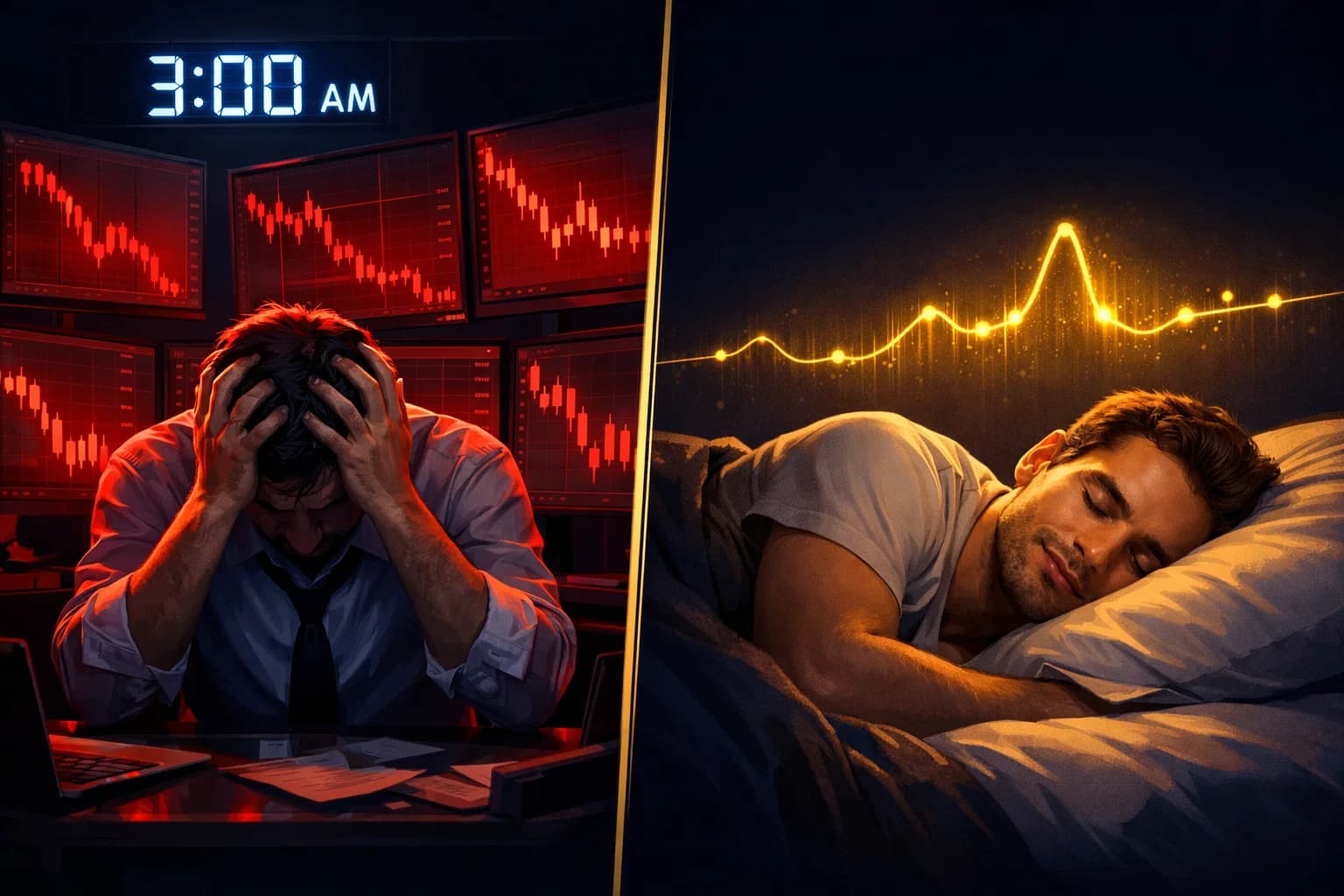
Cryptocurrency markets operate around the clock, fueled by volatility, speculation, and raw human emotion. Studies suggest that between 84% and 95% of retail crypto traders lose money — not because markets are inherently unfair, but because human beings are spectacularly bad at navigating them. Fear, greed, overconfidence, and a catalogue of cognitive biases turn well-meaning investors into their own worst enemies.
This paper examines the psychological traps that ensnare traders, explores the philosophical paradox of whether technical analysis predicts reality or creates it, and argues that the most rational response for the vast majority of people is to remove themselves from the equation entirely.
That is why we built Unic ONE: a spot-only, self-custody portfolio optimization platform for people who do not have the time to stare at charts — and do not want to understand how markets work in order to benefit from them.
1. The Graveyard of Good Intentions
Every day, thousands of new participants enter the crypto market with optimism and a plan. Within months, most have abandoned both.
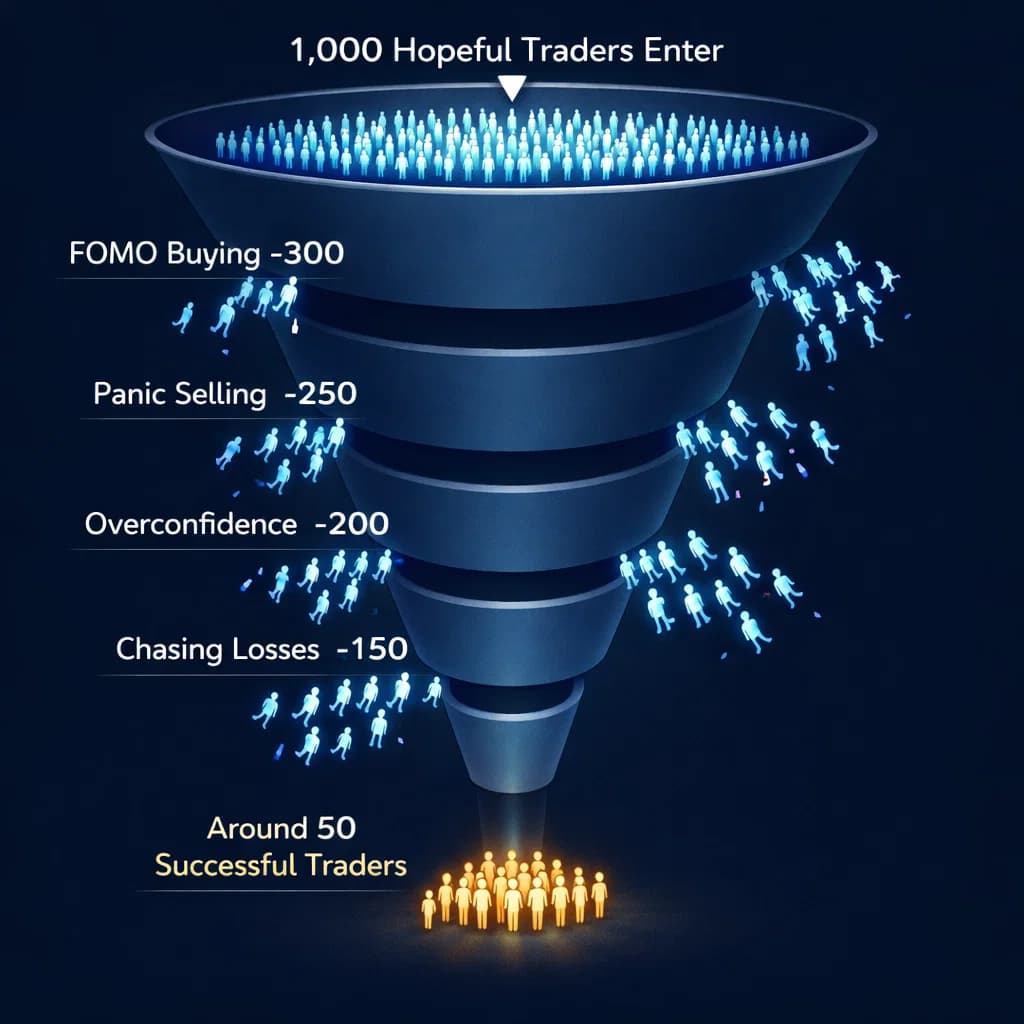
A 2024 study found that 84% of retail crypto traders lose money in their first year, with day trading being the leading cause of losses for 54% of new entrants. Community surveys on platforms like Reddit push that estimate even higher — some experienced investors place the true failure rate at 95–99%, a figure consistent with failure rates in options trading and stock day-trading.
These are not unintelligent people. They are doctors, engineers, entrepreneurs — individuals who succeed in complex domains every day. Yet when they sit in front of a price chart, something goes profoundly wrong.
The cause is not a lack of information. It is human nature itself.
2. The Catalogue of Self-Destruction
Behavioral economists have identified dozens of cognitive biases that affect financial decision-making. In crypto — a 24/7, highly volatile, largely unregulated market — these biases are amplified to devastating effect.
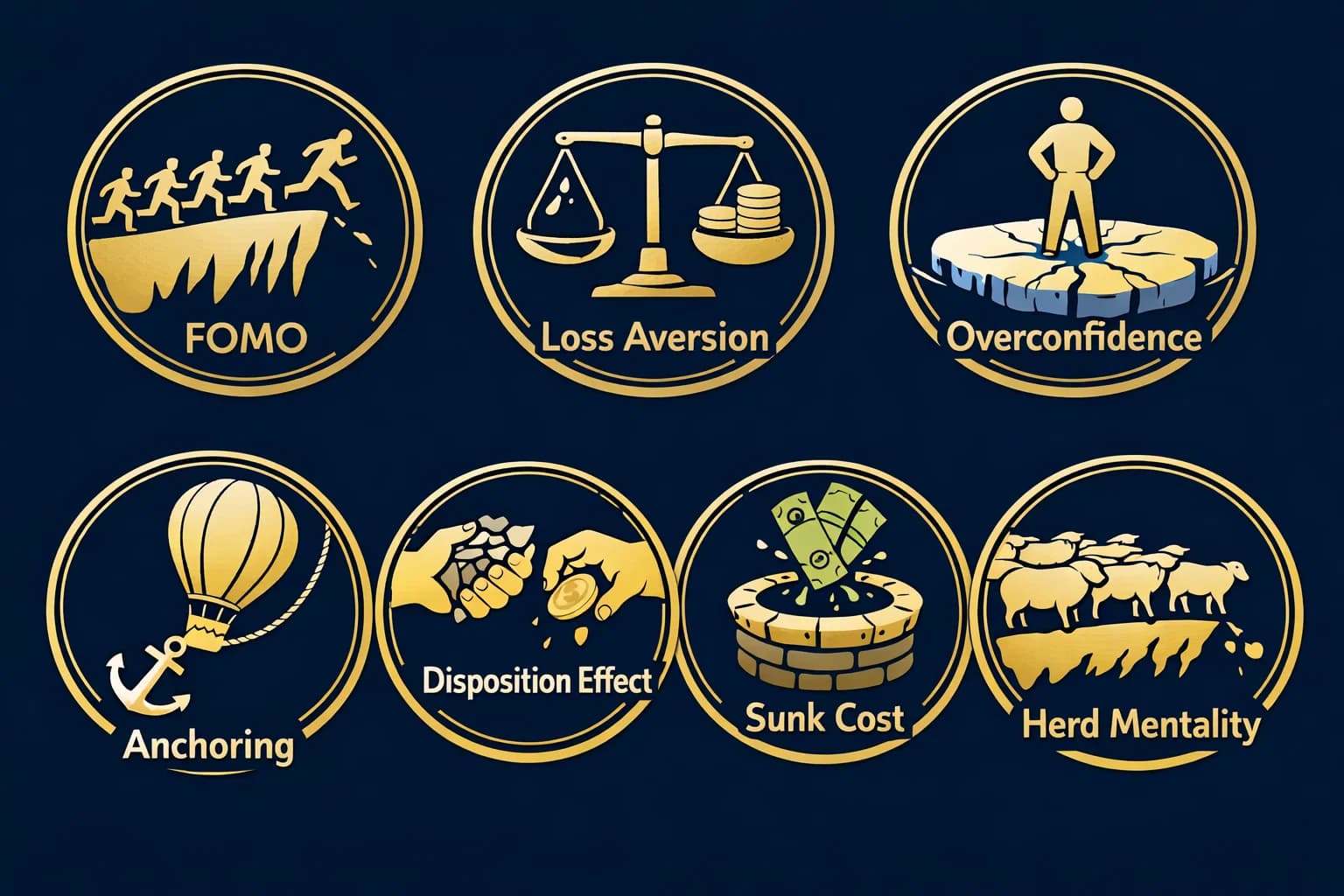
2.1 Fear of Missing Out (FOMO)
When Bitcoin surged toward $100,000 in late 2024, millions of new buyers flooded exchanges. They were not buying because they had analyzed fundamentals. They were buying because everyone else was buying.
FOMO activates the brain's reward system, releasing dopamine and creating a sense of urgency that overrides rational thought. Research from behavioral psychology shows that the fear of missing a potential gain is neurologically indistinguishable from the fear of an actual loss. The result: investors pour money into assets at their peak, buying the top with euphoric confidence.
Bitcoin reached its all-time high of approximately $106,000 on December 17, 2024 — then fell to $79,500 by March 2025. Every FOMO buyer in that window was underwater within weeks.
2.2 Loss Aversion and Panic Selling
Humans are wired to feel losses approximately twice as intensely as equivalent gains — a phenomenon first documented by Kahneman and Tversky in their foundational work on prospect theory. In crypto, where 20% daily swings are unremarkable, this asymmetry is catastrophic.
Consider a trader who buys Ethereum at $4,600 in November 2021. By June 2022, the price has plummeted to $1,065. Unable to endure the psychological pain of watching their portfolio bleed, they sell — locking in a 77% loss. By December 2024, Ethereum is back above $4,000. The market recovered. The trader did not.
This is the cruel irony of loss aversion: the mechanism designed to protect us from harm is the very thing that causes it.
2.3 Overconfidence Bias
Early success in crypto is dangerous. A beginner who doubles their money on a lucky trade develops an illusion of competence. They increase position sizes, take on leverage, and dismiss risk — until the market corrects and erases months of gains in hours.
Overconfidence leads traders to ignore stop-losses, dismiss contrary evidence, and believe they have “cracked the code.” It is the bias behind every leveraged liquidation, every all-in bet on a meme coin, every story of someone who lost their life savings chasing a “sure thing.”
2.4 Anchoring
When you buy Bitcoin at $106,000, that number becomes your psychological anchor. Every price below it feels like a loss, regardless of whether the current price is objectively fair. Anchoring prevents traders from adapting to new information. They hold sinking positions indefinitely, waiting for a return to their entry price — a price the market may never revisit.
2.5 The Disposition Effect
Traders consistently sell winners too early and hold losers too long. This is the disposition effect: the tendency to realize gains prematurely (to lock in the pleasure of winning) while refusing to realize losses (to avoid the pain of admitting a mistake). The net result is a portfolio that systematically sheds its best performers while accumulating its worst.
2.6 The Sunk Cost Fallacy
“I've already invested $20,000 — I can't sell now.” This reasoning, rooted in the sunk cost fallacy, causes traders to throw good money after bad. The amount already spent is irrelevant to whether the current position has merit. Yet humans struggle enormously to treat past costs as irrelevant. In crypto, this manifests as “averaging down” into fundamentally broken projects.
2.7 Herd Mentality
Social media has supercharged herd behavior. When an influencer with millions of followers tweets a coin name, thousands buy within minutes — not because they understand the asset, but because they trust the crowd. Herd mentality drives pump-and-dump cycles, meme coin manias, and the periodic implosion of assets that never had intrinsic value to begin with.
3. The Philosophical Paradox
Do charts describe the world, or create it?
Here lies one of the most fascinating questions in all of finance:
Does technical analysis predict what will happen — or does it cause what happens?
3.1 The Case for Prediction
Technical analysts argue that price charts encode the collective memory of every market participant. Support levels represent prices where buyers historically stepped in. Resistance levels represent prices where sellers dominated. Moving averages smooth noise to reveal trends. These patterns, proponents say, reflect genuine supply and demand dynamics.
In this view, technical analysis is a descriptive science. It reads the footprints that human behavior leaves on price, and uses those footprints to anticipate the next step. The world happens; the chart records it.
3.2 The Case for Self-Fulfilling Prophecy
But here is the paradox: if millions of traders are watching the same moving average, the same support level, the same Fibonacci retracement — and they all act on it simultaneously — then the indicator doesn't predict the bounce. It creates it.
When enough capital flows into a trade because a chart pattern says it should, the pattern becomes true because it was believed. Support holds because buyers believe support will hold. Resistance breaks because sellers believe resistance will break.
This is not metaphysics. It is measurable. Studies of high-volume trading around key technical levels show that the mere existence of widely-observed support and resistance zones concentrates order flow, generating the very price reactions that technical analysis predicted. The map becomes the territory.
3.3 The Ouroboros of Market Belief
The truth may be that both are simultaneously correct — and this is precisely what makes markets so dangerous for human participants.
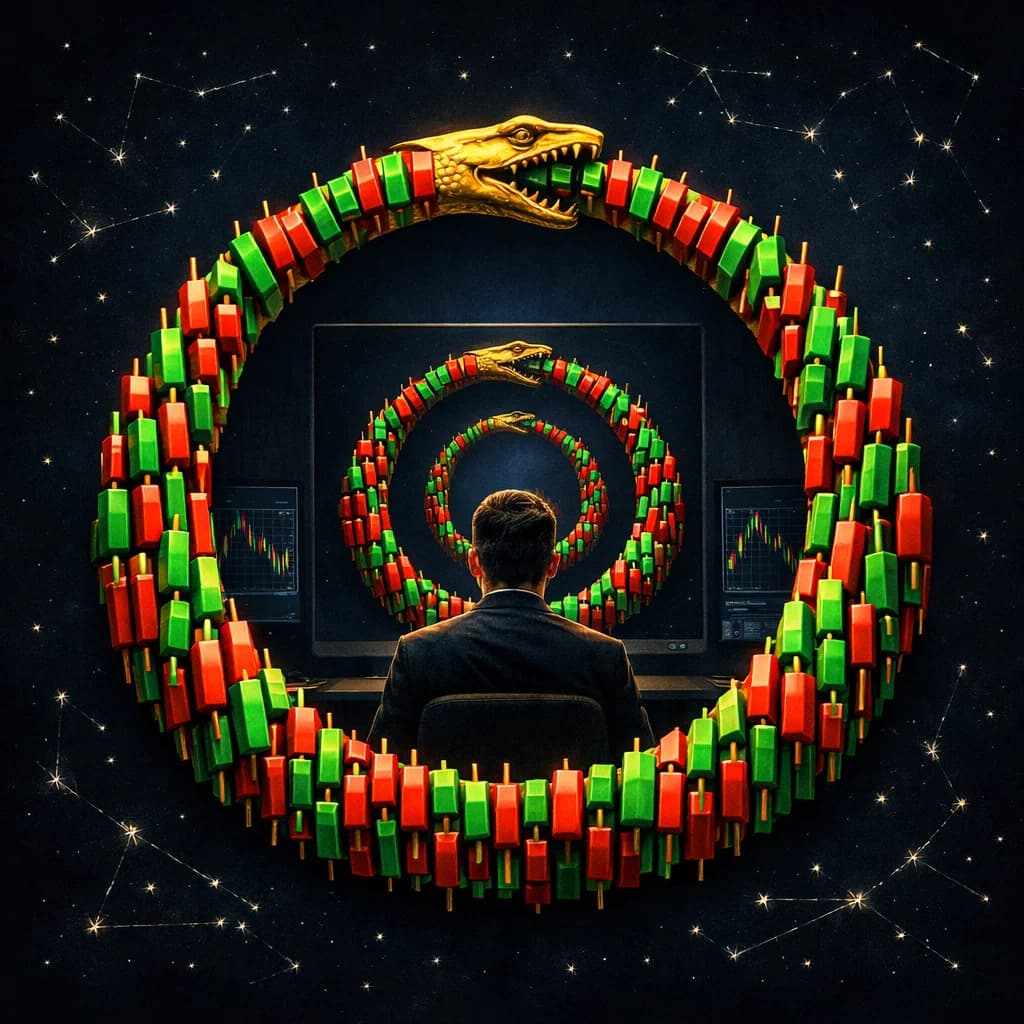
Markets are reflexive systems. Beliefs about prices influence prices, which influence beliefs. George Soros formalized this as the theory of reflexivity: market participants don't just passively observe — they actively shape the reality they are trying to predict. Technical indicators are both mirrors and motors. They reflect crowd psychology and they steer it.
For the average retail trader, this creates an impossible epistemic situation. You are trying to predict a system that changes in response to your predictions. You are reading a chart that is being drawn, in part, by other people reading the same chart. It is an ouroboros — the serpent eating its own tail.
3.4 The Honest Conclusion
Whether technical analysis is a genuine predictive framework or a collective hallucination that occasionally becomes real through sheer force of belief, one thing is clear: it requires a level of interpretive skill, emotional discipline, and time commitment that the vast majority of people do not have — and should not need.
The philosophical debate about whether the chart predicts the world or the world creates the chart is intellectually fascinating. It is also, for most people, entirely beside the point. What matters is the outcome: can you consistently profit from it?
For the overwhelming majority, the answer is no.
4. The Time Problem
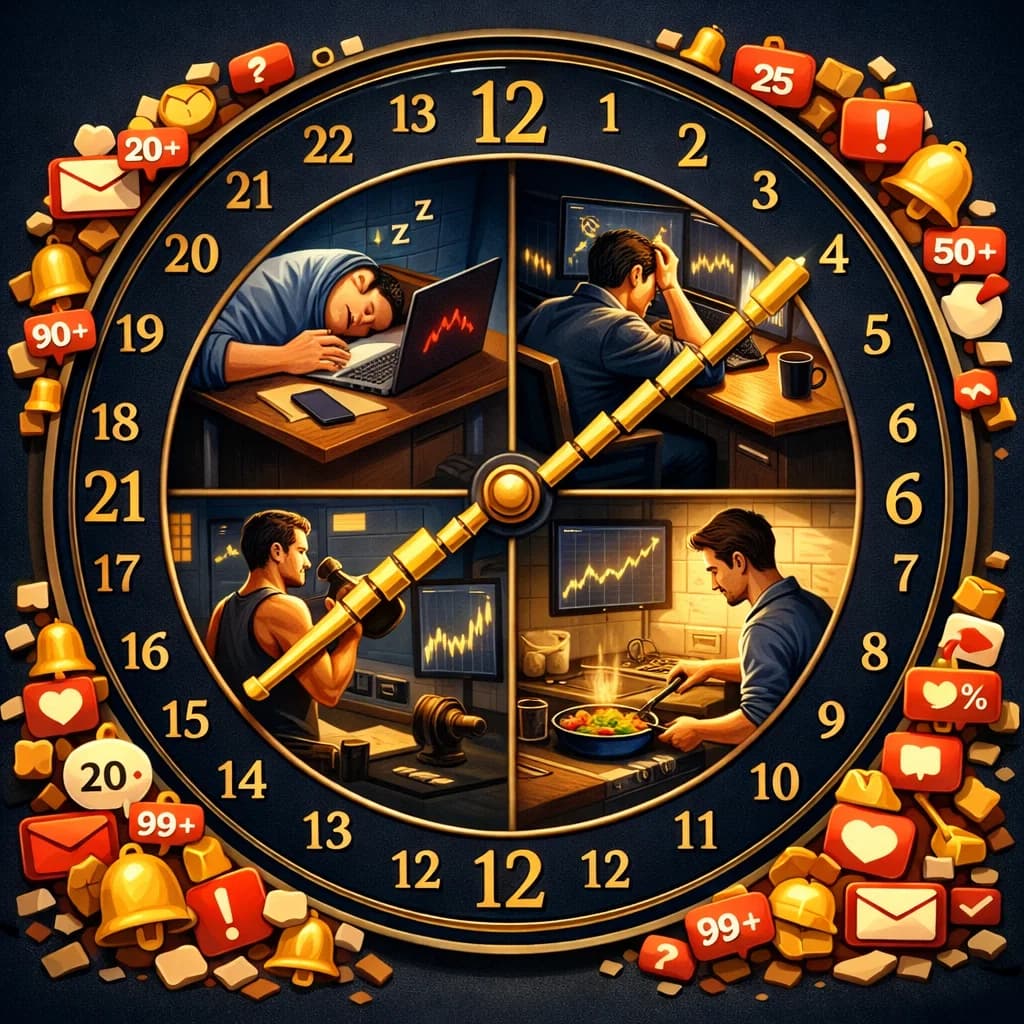
Even if a trader could overcome every cognitive bias — even if they achieved the emotional discipline of a Zen monk — they would still face an insurmountable practical constraint: time.
Crypto markets never close. They operate 24 hours a day, 365 days a year, across every time zone. A significant move can happen at 3 AM on a Sunday. A liquidation cascade can wipe out positions while you sleep. A regulatory announcement in Asia can crash Western markets before your alarm goes off.
Professional trading firms solve this with teams working in shifts, automated systems running around the clock, and infrastructure distributed across continents. The retail trader has none of this. They have a phone, an exchange app, and a job that starts at 8 AM.
The result is that even good decisions made by retail traders are often made too late. The signal came while they were commuting. The entry was missed while they were in a meeting. The stop-loss should have been adjusted while they were putting their children to bed.
5. The Case for Removing the Human
If the human is the weakest link — prone to bias, constrained by time, governed by emotion — then the most rational act a person can take is to remove themselves from the trading loop entirely.
This is not a new insight. Algorithmic trading already dominates institutional finance. By some estimates, over 70% of equity market volume is generated by algorithms. These systems don't panic. They don't FOMO. They don't anchor to a purchase price or refuse to cut a losing position. They execute rules consistently, around the clock, without fatigue.
The advantages of algorithmic execution over human trading are well-documented:
Speed
Algorithms analyze and execute in milliseconds — capturing opportunities humans would miss.
Consistency
Rules are followed identically every time, regardless of market sentiment or personal mood.
Endurance
Algorithms operate 24/7 without rest, monitoring every tick across every market session.
Scalability
The same logic applies whether managing $1,000 or $50 million.
Emotional neutrality
No fear, no greed, no revenge trading, no FOMO. Only data.

But most algorithmic trading platforms present a new problem: they replace one kind of complexity with another. Tools like 3Commas, Cryptohopper, or Coinrule give users the power of automation — but still require them to design strategies, set parameters, configure indicators, and manage bots. The human is still in the loop. The biases still creep in, just one level removed.
6. Why We Built Unic ONE
Unic ONE exists because we believe the answer to human frailty in markets is not more education, more tools, or more discipline. It is less involvement.
We built a platform for people who:
Do not have time to watch charts, follow signals, or manage bots.
Do not want to understand moving averages, Fibonacci levels, or order book dynamics.
Do want to optimize their crypto holdings — rationally, consistently, and without taking reckless risks.
Refuse to give up custody of their funds to a third party.
6.1 The Principles
Spot-only. Always.
Unic ONE operates exclusively on the spot market. No leverage, no margin, no futures, no derivatives. This is not a limitation — it is a design philosophy. Your downside is bounded by what the market does, not amplified by what a contract allows. When the market falls 20%, you lose 20% — not 200%.
Self-custody. Non-negotiable.
Your funds never leave your exchange. Unic ONE connects via API keys with trade-only permissions. We cannot withdraw your funds. We cannot transfer your crypto. The only entity that can move your money is you. This is true today. It will be true always.
Zero configuration. By design.
There are no strategies to set up, no indicators to tune, no grid parameters to configure. You connect your exchange. The algorithm does the rest. This is not a toolkit that requires trading knowledge — it is a managed optimization service that replaces the need for trading knowledge entirely.
24/7 discipline. Without exception.
While you sleep, while you work, while you live your life — the algorithm monitors, analyzes, and executes. It does not panic. It does not get greedy. It does not check Twitter for confirmation bias. It follows the signal.
6.2 The Interface: Simplicity as a Feature
Most trading platforms compete on feature count. More indicators. More chart types. More bot templates. This approach serves traders — people who enjoy the complexity and believe they can use it to gain an edge.
Unic ONE is not for traders. It is for everyone else.
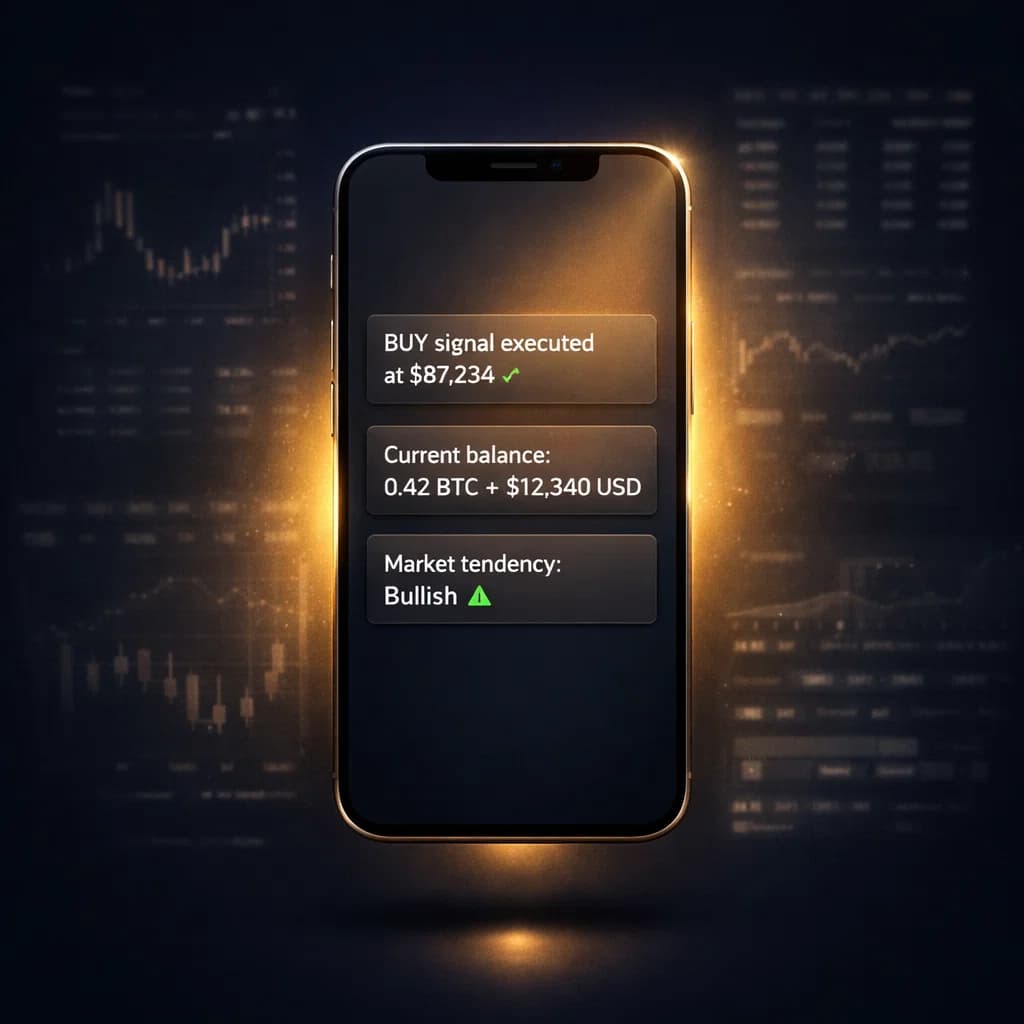
The primary interface is a conversational chatbot delivered through the Hologram Messaging App — a DIDComm-based encrypted channel that pushes signals, executes trades, and reports results in plain language. No dashboards to decipher. No candles to read. Just a calm, clear conversation with an algorithm that works for you.
7. A Different Relationship with Markets
The traditional relationship between an individual and the crypto market is adversarial. You are pitted against professional traders, market makers, algorithmic firms, and your own psychology. The odds are stacked. The house always wins — not because it cheats, but because it never sleeps and never feels.
Unic ONE proposes a different relationship.
You do not need to beat the market.
You do not need to understand the market.
You do not need to watch the market.
You need only to participate in the market — rationally, consistently, and with discipline that no human can sustain manually.
The philosophical debate about whether charts predict reality or create it becomes irrelevant when you are not the one reading the charts. The catalogue of cognitive biases becomes harmless when you are not the one making decisions. The time problem disappears when the system that trades for you never sleeps.
8. Conclusion: Discipline Is Not a Human Virtue
The great lie of the trading industry is that discipline can be learned. That if you just follow your plan, manage your risk, and control your emotions, you will succeed.
But discipline in the face of volatility is not a skill. It is a demand that runs counter to millions of years of evolved psychology. We are built to flee from danger, chase rewards, follow the herd, and anchor to past experiences. These instincts served us well on the savannah. They destroy us in the market.
The honest answer is not more discipline. It is delegation.
Delegate the watching to a system that never tires.
Delegate the analysis to a system that never anchors.
Delegate the execution to a system that never panics.
Keep your funds. Keep your keys. Keep your life.
That is Unic ONE.
References
- CoinJar Research. “The Psychology of Crypto Trading: Why We Make Irrational Decisions.” CoinJar Learn, 2025.
- NFT Evening. “Study: 84% of Retail Crypto Traders Lose Money in Their First Year.” 2024.
- Yahoo Finance / Reddit Community Analysis. “The ‘90% Lose Money’ Crypto Statistic? Experienced Investors Say It's Misleading.” 2025.
- Kahneman, D. & Tversky, A. “Prospect Theory: An Analysis of Decision under Risk.” Econometrica, 47(2), 263–291, 1979.
- Soros, G. The Alchemy of Finance. Simon & Schuster, 1987.
- uTrade Algos. “Why Spot Algorithmic Trading Outperforms Human Traders.” 2024.
- Bank for International Settlements. “Crypto trading and Bitcoin prices: evidence from a new database of retail adoption.” BIS Working Papers No. 1049, 2022.
- European Research Studies Journal. “The Fear of Missing Out (FOMO) Effect in Cryptocurrency Trading: Analyses of Mass Behavior.” Vol. XXVII, 2024.
- PMC / National Library of Medicine. “Cryptocurrency Trading and Associated Mental Health Factors: A Scoping Review.” 2025.
One strategy. One future.